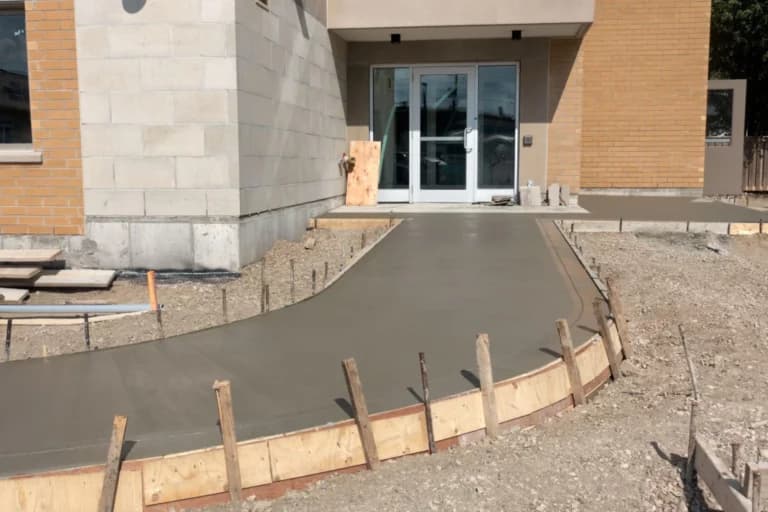
Walkways & Paths in Cary, NC
Professional walkways & paths for homeowners in Cary, Wake County. Free written estimate.
Expert Walkways & Paths in Cary, NC
Connecting walkways and garden paths pitched away from the foundation and jointed to prevent random cracking.
Cary sits on Cecil-Appling clay in most of town, with Enon-Iredell diabase intrusion in the northeast neighborhoods around Sunset Ridge and 12 Oaks. Stamped Concretes in Cary deal with two distinct soil behaviors depending on lot location. Cecil clay holds water and heaves seasonally; diabase-derived soil shrinks aggressively during summer drought. Both problems get solved the same way: proper base preparation. Every stamped concrete pour begins with 4 inches of ABC crushed stone compacted to 95 percent standard proctor density, a 6-mil vapor barrier where the stamped concrete sits within 10 feet of the house foundation, and a 4-inch 3000 PSI slab with 6x6 W1.4/W1.4 welded wire mesh. Expansion joints go every 8 to 10 feet with control joints saw-cut within 12 hours. Broom finish, salt finish, or exposed aggregate are all workable finishes in Cary; salt finish holds up especially well in the shaded lots common in 12 Oaks and Sunset Ridge because it does not show algae staining as aggressively as smooth troweled surfaces. All permits and inspections coordinate through Cary Development Services on West Ballentine Street.
How we build in Cary
Residential stamped concrete in Apex and across Wake County combine three things that determine how long the finished slab lasts: base preparation, slab reinforcement, and joint detailing. Piedmont soils are dominated by Cecil-Appling clay and Wedowee silt loam over decomposed granite, and those soils move seasonally with moisture. A stamped concrete poured directly onto native soil, or onto poorly compacted fill, will crack randomly along weakness lines rather than at the control joints where the crack should be directed. Every stamped concrete we pour begins with subgrade preparation removing organic topsoil, followed by 4 inches of compacted ABC crushed stone at 95 percent standard proctor density. Where the stamped concrete sits within 10 feet of the house foundation, we install a 6-mil vapor barrier under the slab to prevent moisture wicking into the foundation wall.
The slab itself is a 4-inch 3000 PSI residential concrete mix with 6x6 W1.4/W1.4 welded wire mesh chair-supported at mid-depth. Fiber-only reinforcement is an acceptable substitute for smaller residential stamped concretes but we default to wire mesh for anything over 300 square feet or exposed to sustained load. Expansion joints separate the stamped concrete from any fixed structure including the house foundation, pool coping, retaining walls, and columns. Control joints are saw-cut within 12 hours of pour at a depth of one quarter the slab thickness. The joint spacing follows ACI 302 recommendations: 24 to 30 times the slab thickness in feet, or approximately 8 to 10 feet on center for a 4-inch slab. Every joint is snapped and troweled or saw-cut cleanly; no random cracking.
Finishes we routinely install in Apex include broom finish, salt finish, and exposed aggregate. Broom finish is the most economical and provides excellent slip resistance, especially around pool decks and shaded areas. Salt finish uses coarse rock salt broadcast onto the surface during finishing then washed off after cure, producing a pitted texture that resists algae staining better than smooth trowel. Exposed aggregate uses a surface retarder to expose the natural stone within the concrete mix, producing a durable and distinctive finish that lasts decades without recoating. All finishes get a curing compound applied immediately after finishing, and any finish exposed to freeze-thaw gets a 6 percent entrained air content in the mix design.
Pool decks are a specialty. Concrete pool surrounds have to be non-slip when wet, resistant to chlorine and pool chemicals, and detailed with expansion joints separating the deck from the pool coping so the two structures can move independently. Every pool deck we pour uses a broom or salt finish at minimum, a 3000 PSI mix with entrained air, and expansion joints at all coping connections. The deck slopes away from the pool at a minimum 1/8 inch per foot to control surface water. Deck drain tie-ins connect to the property's drainage system before pour.
Covered porches and screened rooms require structural slabs that support the roof and framing above. Every covered porch slab includes a thickened perimeter footing extending to the 12-inch NC frost line, #4 rebar continuous, and a doweled connection to the house foundation. Wake County both require permits for covered porches, and we coordinate the inspection schedule around the pour date.
Ready to get started in Cary?
Free estimates — no obligation. Response within one business hour.
Walkways & Paths in Cary — project photos
Walkways & Paths — Cary FAQs
How much does walkways & paths cost in Cary?
Residential stamped concrete in Apex typically run $7-$16 per square foot depending on thickness, reinforcement, and finish. Pricing bands sourced from Angi 2026 and HomeAdvisor 2026 stamped concrete data.
How long does walkways & paths take in Cary?
Typical 3-7 days on site for a residential project.
Do you handle permits and inspections in Cary?
Yes — every project includes permit paperwork through the Cary planning office and coordination of the required Wake County inspections.
What soil type do you work in around Cary?
Cary sits in NC's Piedmont region on the Cecil-Appling clay and Wedowee silt loam soils typical of the area. Every pour is designed around that soil behavior including base preparation, reinforcement schedule, and joint spacing.
Are you licensed and insured?
Yes. NC general contractor license, full liability, and workers comp. We can provide the certificate before work starts.
Serving Cary, NC
Apex Stamped Co. serves Cary and surrounding areas including Apex, Holly Springs, Morrisville, New Hill.
Walkways & Paths in nearby towns
Get your free walkways & paths estimate in Cary
Apex Stamped Co. — response within one business hour, every day. Written on-site estimate.